From Electrons to Intelligence: Notes from Web Summit Qatar 2026
In early February, Activate Managing Partner Anup Jacob presented at Web Summit Qatar, presenting on the New Electro-Industrial Stack. He brings back this report on the key themes and issues from the event:
 Web Summit Qatar in Doha felt less like a conference and more like a snapshot of where the world is heading. This year brought 30K+ attendees from 127 countries, 1,600+ startups (about 40% founded by women), and nearly 1,000 investors. That’s not just scale—it’s signal.
Across the program, three themes kept recurring: AI, energy, and hardtech. In 2026, those aren’t separate conversations. They’re converging into a single reality: the future economy will be built on computation and the physical systems that power it.
Why Doha, why now
Supercycles don’t reveal themselves in a spreadsheet first. They show up when you hear the same patterns repeating across founders, operators, investors, and policymakers.
Doha is an especially interesting vantage point. It sits at the intersection of global capital, energy fluency, and a founder base that’s becoming more international and more ambitious. When you combine that with a summit that truly convenes the world’s builders, you can feel an ecosystem that wants to play at a global level.
My talk: the Electro-Industrial Stack
On stage, I shared a thesis I’ve been focused on: the new Electro-Industrial stack.
The short version: the next era won’t be won by software alone, and it won’t be won by hardware alone. It will be won by teams that can integrate electrons + intelligence, building systems where the digital and physical worlds reinforce each other.
Over the last decade, the energy system began to shift as renewables, storage, and efficiency improved dramatically on cost and performance. Then the 2020s arrived, and the demand curve changed again.
Watch the session:
AI didn’t just arrive—it rewrote the equation
When large language models hit the mainstream, the energy transition stopped being only a “cleaner supply” story and became a “surging demand” story. Compute at scale is electricity. Data centers are electricity. Training and running models is electricity. At the same time, electrification across transportation and industry continues, and manufacturing is increasingly being reshored or “friend-shored” in a more fragmented geopolitical environment.
All of that is pulling on the same constrained inputs: power, equipment, time, and skilled labor.
This is the Electro-Industrial stack: electrons as the base layer of productivity, and the systems that generate, move, store, and optimize power as inseparable from the systems that generate intelligence.
The watt–bit spread
A hidden dynamic is driving urgency around AI infrastructure. Hyperscalers and infrastructure players are turning electrons into bits—power into computation, computation into intelligence.
The value created on the “bit” side can far exceed the cost on the “watt” side. I describe that gap as the watt–bit spread: the difference between what it costs to produce an electron and what that electron becomes worth once it’s converted into AI output.
When that spread is large, power demand begins to look inelastic. If the marginal value of intelligence is high enough, the system will pay for the watts. That’s why anything tied to dependable power—data center capacity included—is being repriced so quickly.
The constraint: the physical world doesn’t scale like software
Here’s the tension: the physical world doesn’t scale at software speed.
We see it in interconnection queues and permitting timelines. We see it in transformer and switchgear bottlenecks. We see it in the labor market, where skilled trades are aging out faster than we’re training replacements. And we see it most visibly in the data center buildout, where the race for capacity runs into power availability, cooling, and equipment limits.
That’s not a reason for pessimism. It’s a roadmap for where execution has to go next.
Three waves (we’re in Wave 2)
Most technology supercycles follow a rhythm:
- Core innovation (chips, compute, foundational platforms)
- Infrastructure build-out (networks, data centers—and now power systems)
- Applications that endure
Right now, we’re firmly in Wave 2. But this cycle’s infrastructure is broader than cloud alone, because it’s electro-industrial: generation, transmission, distribution, load management, thermal management, materials, manufacturing capacity, and financing structures.
Where the attach points are forming
If electrons are becoming the constraint, a few attach points matter most:
- Grid modernization and orchestration: making power more available, more predictable, and more valuable
- The physical “plumbing” of AI: power electronics, cooling, reliability, and uptime tooling
- Industrial supply chains and capital structures: accelerating buildout without breaking the risk model
The winners won’t just be great storytellers. They’ll be great integrators: teams that can execute in the real world with software-like iteration speed.
A highlight off the main stage: the climate breakfast
One of my favorite moments in Doha happened outside the spotlight: a climate breakfast hosted by Omnivore, Venture Souq, and The Radical Fund. About 60 investors and founders showed up early, and the room had exactly the kind of energy you want to see—practical conversations, real collaboration, and a clear appetite to build. Conferences create headlines; breakfasts like that create compounding.
Questlove, Colin Kaepernick, and optimism as a discipline
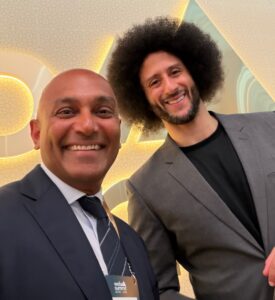
On a personal note, one of my highlights was listening to—and meeting—Questlove and Colin Kaepernick. It was a reminder that technology doesn’t happen in a vacuum. Culture and conviction shape what gets built, who gets to participate, and what we choose to optimize for.
I left Doha feeling something I don’t take for granted: optimism. The next decade will be defined by the collision of bits and atoms—by systems that turn energy into intelligence, and intelligence into real-world outcomes.
But it only happens if we solve the base layer: electrons. If you’re building anywhere in this Electro-Industrial stack—or navigating the bottlenecks and opportunities forming right now—let’s keep the conversation going.
Related Articles